AP-HM · 2026
Training the hospital management on generative AI
For the Assistance Publique-Hôpitaux de Marseille, an upskilling programme built for the management layer — directors, department heads, administrative leadership.
Management upskilling


Working document prepared for Audemars Piguet. May 2026.
This is not a standard commercial outreach. Audemars Piguet is an organisation with which we want to engage a structured partnership conversation. Albert School, on its side, has just reached the scale where it can be a partner at scale.
Mines Paris-PSL (founding member of Université PSL, #28 worldwide QS Rankings) + European founders (Xavier Niel, Bernard Arnault, Rodolphe Saadé).
Five integrated years Bachelor → Master across four pillars: Mathematics, Business, Data, Humanities. Tracks in Data for Business, Finance, Sustainability + MSc AI & Entrepreneurship in apprenticeship.
650 students · 5 campuses (Paris, Madrid, Milan, Geneva, Marseille) · 38 nationalities · founded in 2021.
The school has reached the inflection point where it cannot scale by adding programs alone. The next chapter is a deliberate move to build a network of partner companies engaged on the long horizon — talent, training, research, innovation. We call it Future Partners. It is the architecture for how Albert School and the most ambitious organisations in Europe grow together.
A continuous pipeline of hybrid graduates — Business × Data × AI × Humanities — flowing into partner organisations through internships, apprenticeships, and full-time hires.
Executive Education designed for how teams operate when AI augments individual output. Bespoke interventions, calibrated to the partner's reality.
Joint research on the transformations AI imposes on training, hiring, and management. A space where partner companies and academic teams build the playbook for the next decade.
Future Partners is a small network by design. We are choosing the organisations we want to walk this path with — selecting partners that hold a singular standard in their sector. Audemars Piguet is a priority partner for us.
The Future Partners architecture exists to address three precise ruptures AI has opened. Every program Albert School delivers — Executive Education, Business Deep Dives, apprenticeship pipelines, joint research — is calibrated against these three. Presented here because they are the conceptual scaffolding for everything that follows.
Frameworks, tools, methods that professionals learn this year are largely obsolete in three. No fixed curriculum survives contact with the real world long enough to justify itself. The only durable response is to build the capacity to learn fast, alone, on any new tool — not to keep updating the content around the learner.
Before AI, not knowing created friction. You had to search, ask, consult — and the act of searching produced a metacognitive signal that told you where your understanding ended. AI has eliminated that friction. A professional can produce fluent, confident, well-structured analysis on topics they do not understand — with no warning signal. The most dangerous junior in any organisation is the one who, armed with AI, produces polished wrong work at scale, and has never been trained to doubt it.
A skilled professional using AI today produces — conservatively — twice what they produced without it. No HR framework has moved to reflect this. Accreditation, performance evaluation, career progression, team composition, salary bands — all built around the old standard. For organisations whose competitive advantage depends on attracting and growing rare talent, this is the structural challenge of the next five years.
Over the last twelve months, we have specialised our Executive Education practice around a simple matrix. Three rows for the level of intervention — individual, team, governance. Two columns for the stage of the partner organisation's AI journey — ideation of the AI roadmap, or prioritisation and roll-out at scale. Six cells, each a different conversation. For Audemars Piguet, the right entry point depends on where you stand on this map — and is something we want to calibrate together.
Our Executive Education offer is designed to activate as a complement to your internal capability — wherever you stand on the matrix. Whether the priority is broad acculturation, an AI Ambassador community for your business lines, or an ExCo-level conversation on cost trajectory, change management and governance, the format calibrates to the actual question on the table. Not a substitute to your internal organism; a calibrated complement.
Three delivered cases, one per row of the matrix — to give the range.
For the Assistance Publique-Hôpitaux de Marseille, an upskilling programme built for the management layer — directors, department heads, administrative leadership.
AI Ambassador programme training internal relays in each business line — HR, marketing, operations, finance. The multiplier, not frontal training.
One immersive day per executive committee. Strategic kickoff, hands-on Copilot workshop, agents workshop with POC construction. Format replicated identically across 20 cohorts. Satisfaction sustained at 8.7/10.
Each engagement was custom. None is a template we re-applied. That is the point — Executive Education at Albert School calibrates to the actual question on the table, not to a pre-packaged curriculum.
A real brief. A student team. From 2 days to 4 weeks of supervised work. A final presentation to the company jury. For a group like Audemars Piguet, with dozens of strategic questions in a sector under fast transformation, the BDD is the format that converts curiosity into a concrete deliverable — and puts your teams in direct contact with a cohort of Business × Data × AI × Humanities students.
Compressed format for short strategic questions.
Standard format. Business, data, or AI case framed by Albert coaches.
Prototype format. Students deliver a tangible artefact.
Tri-partite with a Mines Paris-PSL research lab. For topics where science is a lever.
Pure entrepreneurial format with internal mentors.
8 BDDs per Bachelor student per year. No repeat of company-format pairings. Multi-campus, cross-track, year-round. For Audemars Piguet, whose international footprint spans manufacture, distribution and brand, this means a permanent calendar of engagement windows — short or long — triggered on demand, and anchored in the geography where you want them.


Five centuries separate the two images above. They share an idea that no other institution reproduces. A school is the place where disciplines converge, where talent is formed across cohorts, where knowledge is built rather than purchased. For Audemars Piguet, the practical implication is direct: the value Albert can deliver — talent flow, applied research, multi-disciplinary breadth, generational time horizon, institutional credibility — is what a vendor relationship by structure cannot.
Students entering your organisation through apprenticeship, internship, and full-time hire. A training provider has no graduating cohort. A school does — every year, by design.
Applied research, co-publication, co-funding on the long horizon. A training provider delivers content. A school produces knowledge — and shares the authorship.
Mathematics, Business, Data, Humanities — under one roof, in the same curriculum. A training provider specialises in one slice. A school holds the whole and connects the parts.
Student cohorts grow with you for ten, twenty years. The relationship compounds. A training provider's contract is annual; a school's is generational.
Mines Paris-PSL as founding partner. Leading European entrepreneurs as backers. A school carries the weight of the institutions behind it — not just the trainers it deploys.
This is why the conversation Albert School wants to have with Audemars Piguet is a partnership conversation — not a vendor conversation. The next sections describe the framework, the mechanic, and the combinations we want to test with you.
The Future Partners framework articulates six dimensions of the partnership. None is mandatory; none is exclusive. For Audemars Piguet, the natural entry point is an ExecEd journey to upskill their teams, combined with the opportunity to scale the impact and build further through a Studio Business Deep Dive. But the conversation we want to open is broader: which mix of pillars makes sense for you over the next twelve to twenty-four months, and at what cadence?
Company presentations, recruitment, internships, apprenticeships, early-career opportunities.
Real briefs, structured as pedagogical projects. The visibility format and entry point to the broader collaboration.
Custom programmes for managers and teams. Activated for specific transformations.
A protected space to prototype AI use cases, test emerging topics, challenge hypotheses.
Co-creation of content, events, panels, white papers, executive briefings on the future of work and AI transformation.
A curated network of organisations engaged on the same questions — peers walking the same path.
For the deepest engagements, we are opening conversations on co-funded research chairs — applied, co-authored, co-published. A way to give the questions that matter most to Audemars Piguet a structuring academic voice on the long horizon.
The framework works because each pillar of engagement reinforces every other pillar — for both sides. Albert School gets richer cases, stronger placements, sharper reputation. The partner organisation gets earlier access to talent, faster AI adoption, stronger competitive position. The two flywheels are coupled: a turn on one side accelerates the other. Below, the two loops side by side.
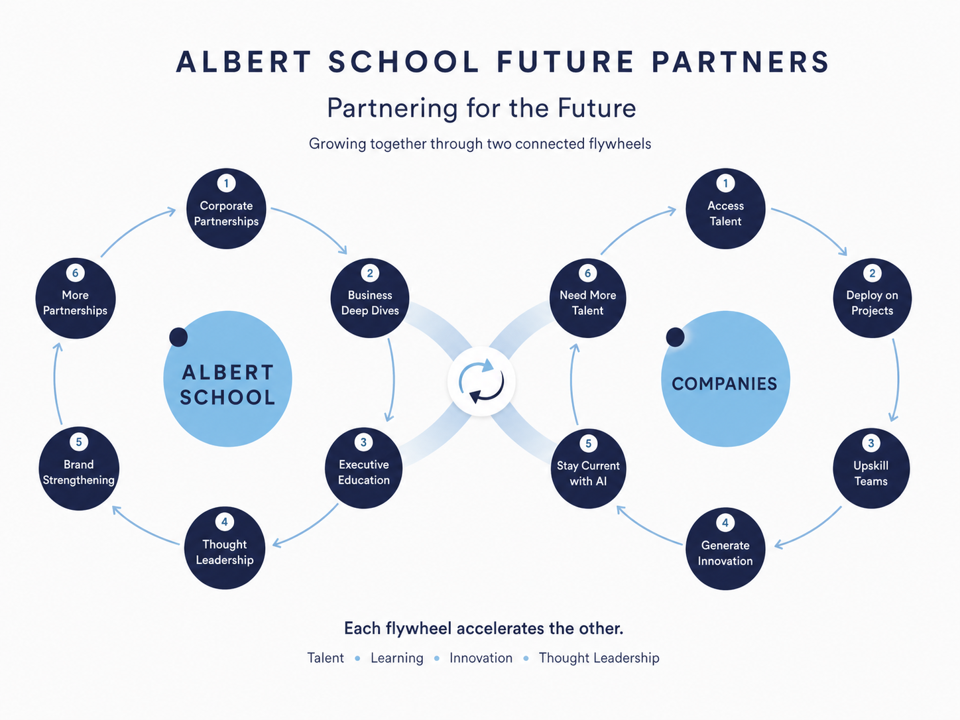
Albert School supplies the partner with talent and applied research. The partner supplies Albert with real cases and reputation. Each turn on one side accelerates the other. For Audemars Piguet, the loop has not yet started turning. That is precisely what this page proposes: start a first turn, and observe together how the two flywheels amplify each other.
The single-pillar engagement model — a BDD alone, an ExecEd module alone — has taken us a long way. The next horizon is in the combinations. The pairing below is a net new format we will be testing with a small number of priority partners next year. Audemars Piguet is an institution with which we'd like to open the test — for the breadth of strategic questions you face, and for the long horizon you operate on.
What it is: a partner organisation runs a Business Deep Dive on a strategic question — and the team inside the organisation that owns the question goes through a calibrated Executive Education module in parallel. Two parallel learning curves, one shared question. A net new format we are opening to a small number of priority partners next year.
What it could be at Audemars Piguet: an ExecEd journey to upskill the teams that own AI inside the group, paired with a Studio Business Deep Dive on a strategic question chosen by your teams — for instance on the integration of AI into design, manufacturing or client relationship workflows. Two parallel learning curves, one shared strategic question.
This combination is designed to be tested at scale. Audemars Piguet has both the breadth and the strategic urgency to put it in motion — and would be among the first priority partners to run it next year.
No fixed menu. No bundle to sign in one block. Three concrete paths that can be activated independently or together, at your pace.
A group-wide ExecEd journey calibrated to Audemars Piguet's reality — designed to upskill the 3,000 collaborators on AI: from foundational fluency for individual productivity, to AI Ambassador communities inside the business lines, to an ExCo-level conversation on governance, cost trajectory and change management. Scope and cadence to calibrate together.
→ See the detailed proposal belowA BDD on a topic Audemars Piguet chooses — Business Challenge (3 weeks, broad strategic question) or Studio (3 weeks or sprint, tangible prototype). Format to calibrate together at the next conversation.
A 2- or 3-year framework agreement between the two groups, covering the Future Partners menu and allowing each pillar to be activated without renegotiation. The point is to keep Audemars Piguet's AI strategy a living framework — revisited, recalibrated and extended together as the technology, the teams and the questions evolve.
On 21 May, you told us what you want to build — an AI Academy reaching every collaborator at Audemars Piguet, calibrated to your tools, your manifesto, your governance. What follows is our response. The shape of the journey, the chapters, the differentiator we want to bring, the timeline, and the inputs we need from you to make the September launch comfortable.
A short recap, so we are on the same map.
Reach the 3,000 collaborators across the group, not only the managers or the IT population. One shared baseline, then deeper paths where they are needed.
Not a one- or two-day format. A journey, with a common base on your LMS (asynchronous), and webinars or live moments stacked on top once the base is acquired. In-person and communities of practice possible for the Swiss population.
A common base plus a few tracks by métier (fonctions support, horlogers à l'établi, commerciale, finance) — without multiplying the complexity.
No citizen developers. Innovation stays piloted centrally by IT, via demand management. The Academy's job is to make every collaborator a fluent user and an opportunity-spotter, not an uncontrolled builder.
Move people from "I am afraid of the technology" to "the technology is my ally" — and create the reflex to surface qualified use cases through your existing demand process.
Q3 launch — September or October 2026. The June scoping call sets the build window for July–August.
Two angles you made explicit at the end of the call — bottom-up innovation where every collaborator has a contribution to make, and a living AI roadmap kept fresh as the technology and the teams evolve — are the two angles we use to structure the rest of this proposal.
Fully online, modular, refreshable, measurable. Built on what already exists at AP — Copilot for daily operations, custom models under Swiss sovereignty, the AI manifesto as the rule book. One shared journey, then targeted specialisation for the populations that need more.
Every collaborator follows the same AI for All journey, built as short content bites consumable between two meetings or from the workshop floor. A personal learning partner guides each individual through it. Populations that need more then get more: managers, and métier deep-dives.
Short faculty films, demonstrations and quizzes. Engagement at distance is a design problem, not a channel problem.
Each chapter grounded in real AP tasks and real AP use cases. No abstract theory.
Built in versioned units with a quarterly refresh cycle, so the programme stays current as the technology moves.
Completion, progression and 30-day application tracked per population and reported to the Data Office.
Understand the landscape, use AI safely, master the everyday tool and a shared way to talk to it, understand what agents change, and turn ideas into governed use cases. The journey closes with a certification quiz and an AI Ally badge — friendly for internal communication, and a measurable adoption signal for the Data Office.
A shared, jargon-free understanding of AI, ML, deep learning and generative AI, illustrated with the real use cases a watchmaker, a boutique advisor and a finance analyst recognise. The points to watch: shadow AI, the EU AI Act, the limits of generative AI.
Takeaway — A shared language and a clear picture of what AI changes for AP, before any tool is touched.
The AP manifesto turned into everyday rules. Risk, governance, sensitivity levels. Shadow AI: the concrete moments when a public chatbot becomes a leak, and the compliant alternative inside the AP environment. Bias, hallucination and verification.
Takeaway — Confident, compliant daily use, and a workforce that protects AP by reflex.
One house prompting method, reused everywhere — context, role, task, format, iteration. Copilot Chat in practice, inside the AP environment: short video pack to level everyone, then practical exercises spaced over the weeks (catching up after absence, drafting sensitive messages, summarising long documents, preparing meetings, building recurring Excel reports). Cumulative and low pressure, so usage actually sticks.
Takeaway — One common prompting language, and three to five Copilot routines each participant uses every week.
How agents work, what they can and cannot do, how they differ from a chatbot. The patterns that pay off (automated watch, document retrieval, recurring synthesis) and the ones that do not. Governance of agents: where decisions stay human, why building stays under IT.
Takeaway — An informed view of agentic AI, so AP can capture its value while keeping governance with IT.
What makes a good AI use case — value and feasibility, illustrated with the 2025 capstone themes (augmented client experience, supply chain and traceability, enhanced employee workflows). How to write a one-page business case. The governance path: how a submitted case reaches the Data Office.
Takeaway — A pipeline of qualified, employee-sourced use cases feeding the Data Office, without citizen-developer sprawl.
A personal learning partner accompanies every collaborator through the journey: an AI that assesses them, guides them, answers them, and keeps them moving. The message of the programme is embodied in its delivery.
Online training fails for two predictable reasons: people drift away, and one-size content fits no one. A partner that adapts to each person solves both. It recreates, for 3,000 people at once, the attention of a tutor who knows where you are and what you need next.
Spaced nudges, follow-up, and a pathway that adapts as people progress keep them coming back. Engagement is designed in, not hoped for. Questions asked along the way feed back, so recurring blockers get answered for everyone.
Every collaborator gets a personal pathway: their own diagnostic, their own recommended next steps, their own tutor. Impossible to staff with humans at 3,000 people; native for the partner.
Access is not usage. The partner drives the work: it diagnoses the gap, recommends the next bite, nudges the people falling behind, and answers the question that would otherwise stop someone. It turns a licence into a trained employee.
A live series on what AI changes for roles, processes, hiring and performance. Managers work on the business cases their own teams submit in Chapter V — learning to evaluate and prioritise rather than to build. Each manager leaves with one process-redesign proposal.
The right way to slice 3,000 people into métier tracks depends on how AP is actually organised. We would want to agree it with you. An organigram is the fastest way to get there.
Albert School programmes are taught by a mix of academics and practitioners. The list below shows the pool we draw from; the final lineup is confirmed at contracting, with equivalent profiles guaranteed.
Associate Professor, CentraleSupélec & Paris-Saclay
AI and LLM fundamentals; levelling mixed-ability groups
Professor, Mines Paris-PSL · European Control Award 2021
AI fundamentals and the science behind the tools
Professor, INSEAD and LSE
Generative AI for business; framing use cases
PhD INRIA, lecturer EM Lyon
How generative AI works; RAG and the data behind it
Global Solutions Strategy, Microsoft
What companies do with AI today; benchmarks and AI maturity
Palantir
AI maturity diagnosis; large-scale deployment
AI policy and law counsel
Responsible AI, ethics and safety; the AI manifesto
Lecturer, Sciences Po Paris
AI Act, GDPR, regulation and responsibility
Responsible AI researcher, AXA
AI Act in practice, governance and fairness
Co-founder Acqua.ai, ex-HyperloopTT
Hands-on facilitation, Copilot, collective intelligence
Co-founder AI Partners, ex-Jellyfish
Prompt engineering, Copilot, applied business cases
CEO, Factuelle
Applied automation and ROI for operational teams
Data Scientist, Sicara; lecturer Centrale Paris
Advanced Copilot and agentic workflows
Lead Data Scientist, Schneider Electric; PhD NLP
Generative AI in production; agentic systems
AI trainer, Télécom ParisTech
Prompting and LLM operations
Machine Learnia (200k subscribers)
Accessible ML and deep learning for large audiences
OpenClassroom
AI fundamentals for beginners
Albert School teacher, ex-Blue Prism
ML and deep learning fundamentals; automation
MVA ENS Paris-Saclay
RAG, APIs and technical depth
Founder, AI Forward (ESCP)
Spotting and prioritising use cases
ex-McKinsey, HBS MBA; teaches HEC and ESSEC
Use-case prioritisation for leaders
École Polytechnique, ESSEC and HEC
Business case and use-case prioritisation
AI and Data Transformation Director, Decathlon
AI roadmap and business case at scale
Founder, Suneris
Change management, usage charters, leading AI projects
Data and AI strategy advisor
AI strategy and transformation
AI and data advisor
AI transformation and governance
Supply chain and data programme director
Manufacturing, traceability, supply chain use cases
No-code developer, Inside Albert
Copilot Studio and no-code, for advanced cohorts
No-code and AI automation expert
Automation and agent building, for advanced cohorts
Director of Executive Education, Albert School
Programme direction and the AI-for-leaders framing
Validation of the chapters and tracks, the métier split (organigram), technical setup (LMS, SSO, languages), and the personal learning partner decision.
Content production with review checkpoints with your team; manifesto integration; partner configuration if retained.
Progressive waves by function and site; monthly steering with the Data Office.
Adoption, skills progression, and the business-case pipeline generated by the programme.
The figures below are indicative. A detailed quote follows the scoping call once the cohort plan and options are fixed.
| Building block | Indicative price | Basis |
|---|---|---|
| Pedagogical design and production of the AI for All journey (content bites, faculty films, bilingual FR/EN) | EUR 50,000 – 70,000 | One-off build on AP material |
| Access to your learning journey assistant, hosting and quarterly content refresh | €25 per user per year | Up to 3,000 learners · Diagnostic, recommendation, tutoring and adoption dashboards |
| Extra live practice sessions (Copilot rhythm, specialisations, advanced topics) | EUR 1,500 – 2,000 / session | Volume set by the cohort plan |
| Blended in-person days at Le Brassus (optional) | EUR 8,000 – 10,000 / day | Capstone format for Swiss-based cohorts |
The September launch date drives the calendar: a decision on the core programme by end of June keeps the build window comfortable. The personal learning partner can be confirmed up to four weeks later without affecting the launch.
Reply to Angelo →The official school presentation — for anything beyond today's conversation.